The $195 Billion Problem That's Destroying American Credit Scores (And How to Fight Back)
Right now, as you're reading this, there's a 43% chance you have medical debt sitting in collections.
You might not even know it's there.
That routine blood test from two years ago? The emergency room visit your insurance "forgot" to cover? The physical therapy sessions where the billing department never submitted to your insurance?
They're all ticking time bombs on your credit report.
The Medical Debt Trap Nobody Talks About
Here's what makes medical collections different from every other type of debt:
You never agreed to the price.
Think about it. When you buy a car, you negotiate. When you sign up for a credit card, you see the terms. When you take out a mortgage, you shop around.
But when you're wheeled into an emergency room at 2 AM? You're not asking for an itemized estimate. You're not comparison shopping. You're not negotiating.
You're just trying to survive.
And six months later, a collections letter shows up demanding $3,847 for services you can't even remember receiving.
The Dirty Secret of Medical Billing
Medical billing is a catastrophe by design.
A 2020 study found that 80% of medical bills contain errors. Not typos. Not minor mistakes. Actual overcharges, duplicate billing, and services you never received.
Insurance companies deny claims at random, hoping you won't notice. Hospitals charge $15 for a single ibuprofen tablet. Collection agencies buy your debt for pennies on the dollar and then demand full payment from you.
And the entire system is designed to confuse you into just paying whatever they ask.
Why Paying Medical Collections Can Backfire
Here's the trap most people fall into:
You see a medical collection on your credit report. You panic. You pay it immediately to "fix" your credit.
Big mistake.
Paying a collection doesn't remove it from your credit report. It just changes the status from "unpaid" to "paid." Your credit score? Still damaged.
You just spent hundreds or thousands of dollars... and got nothing in return except the satisfaction of enriching a collection agency that bought your debt for 4 cents on the dollar.
There's a smarter way.
The Three Things You Must Do Before Paying (Or Disputing) Any Medical Collection
1. Verify the Debt Is Actually Valid
Collection agencies are legally required to prove you owe the debt. But most people never ask for proof.
They just assume the collection is legitimate and start making payments.
Here's what you need to demand:
- Itemized bills showing exactly what you were charged for
- Proof your insurance was properly billed
- Documentation that the services were actually rendered
- Evidence the collection agency has legal right to collect
Spoiler: Most collection agencies can't provide all of this. And if they can't prove it, they can't collect it.
2. Check for Violations
The Fair Debt Collection Practices Act gives you powerful rights. Collection agencies violate these rights constantly because most people don't know they exist.
Are they calling you before 8 AM or after 9 PM? Violation.
Did they report your debt before the 365-day waiting period? Violation.
Are they threatening actions they can't legally take? Violation.
Each violation is worth up to $1,000 in damages. Suddenly, that $500 collection they're harassing you about becomes leverage.
3. Look for Billing Errors (They're Everywhere)
Remember that 80% error rate? Here are the most common:
- Insurance processing failures - Your claim was never submitted, or was submitted incorrectly
- Coding errors - Wrong procedure codes that inflate your bill
- Duplicate charges - The same service billed multiple times
- Unbundling - Charging separately for services that should be bundled together
- Balance billing - Charging you for out-of-network services in an emergency (illegal since 2022)
A single coding error can turn a $200 bill into a $2,000 collection.
The New Rules That Changed Everything
Most people don't know that medical collections rules changed dramatically in 2022:
- Medical collections under $500 no longer appear on credit reports
- Collections must wait 365 days before being reported (up from 180 days)
- Paid medical collections are now removed from your credit report entirely
But here's the catch: These rules only help you if you know how to use them.
Collection agencies are betting you don't.
What to Do Right Now
If you have medical collections on your credit report, here's your immediate action plan:
Step 1: Pull all three credit reports (Experian, Equifax, TransUnion) and identify every medical collection.
Step 2: Don't pay anything yet. Seriously. Not a dime.
Step 3: Send debt validation letters demanding proof within 30 days of first contact.
Step 4: Analyze your insurance Explanation of Benefits (EOB) for processing errors.
Step 5: Document every violation, every error, every inconsistency.
Step 6: Dispute from a position of strength, not desperation.
This isn't about trying to get out of legitimate debt. This is about making sure you're not being scammed by a broken system that profits from your confusion.
Your Free Pre-Dispute Preparation Guide
Look, I know this is overwhelming.
Medical collections are deliberately complex because complexity generates profits. The more confused you are, the more likely you are to just pay whatever they demand.
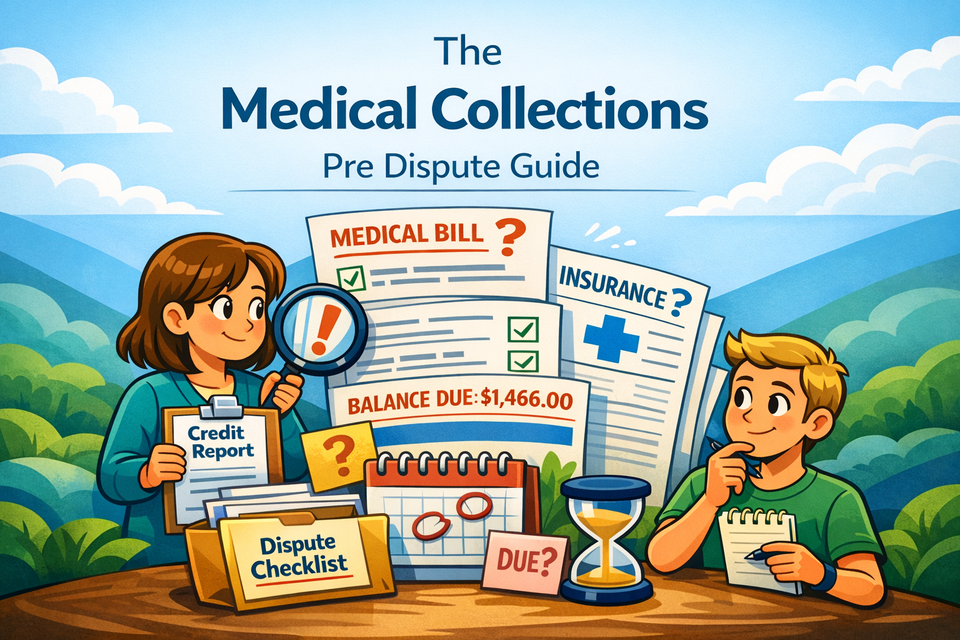
That's why I created a complete Medical Collections Pre-Dispute Guide that walks you through every single step of the verification and dispute process.
Inside, you'll discover:
- The complete documentation checklist before you challenge any collection
- Exactly what to request in your debt validation letters (word-for-word)
- How to identify the most common medical billing errors (with real examples)
- Your rights under FDCPA, FCRA, and HIPAA that collection agencies hope you never learn
- The 4-week action plan to go from confusion to clarity
- Red flag violations that instantly strengthen your negotiating position
- State-specific laws that might protect you even more than federal laws
- When to negotiate, when to dispute, and when to lawyer up
This isn't legal advice (I'm not a lawyer). This is educational information that puts you on equal footing with the people trying to collect from you.
Download Your Free Medical Collections Pre-Dispute Guide Here
No email required. No strings attached. Just click, download, and start protecting yourself.
The Bottom Line
Medical debt has destroyed millions of credit scores.
Not because people were irresponsible. Not because they refused to pay legitimate bills.
But because they didn't know the system was rigged against them from the start.
You have more power than you think. More rights than they want you to know about. More options than just "pay or die."
But only if you know what you're doing.
Don't let a broken healthcare billing system ruin your financial future.
Arm yourself with knowledge. Verify before you pay. Dispute from strength.
Your credit score will thank you.
About the Author: Eric Coste helps people navigate the complex world of credit repair and personal finance. His mission is simple: give people the tools to fight back against systems designed to confuse and exploit them.
Ready to take control? Download the Medical Collections Pre-Dispute Guide and start your journey to credit freedom today.
Comments ()